

The electricity transmission network: Europe's power motorways
In short: the transmission network carries electricity at very high voltage from power plants to city networks, and across borders. In each country one company, the transmission system operator (TSO), runs it.
This is Part 3 of the series. We have seen generation; now let us see how energy travels.
The motorways of electricity
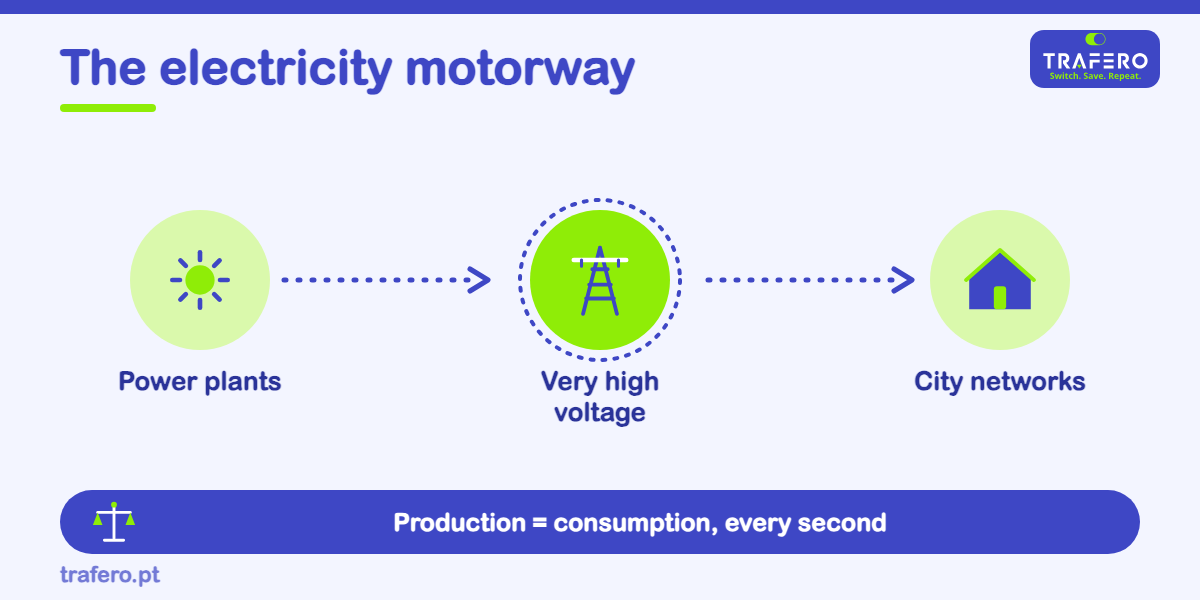
Power plants are often far from cities. For the energy to get there without being lost on the way, the transmission network works at very high voltage. It is like a motorway: it carries a lot of energy, fast and over long distances. Lines also cross borders, so a country can send power to its neighbours and receive it when needed.
Who runs the network?
Each country has a transmission system operator, for example REN in Portugal, Red Eléctrica in Spain, RTE in France, Terna in Italy and Transelectrica in Romania. TSOs plan the grid years ahead, make sure it is ready for new consumption and new generation, especially renewable, and cooperate through the European network ENTSO-E.
Balance in real time
Because electricity is hard to store, what is produced must equal what is consumed at every moment. The TSO follows everything in real time and decides which plants come on or go off, so there is energy in high-demand hours ("peak") and low-demand hours ("off-peak").
Does this affect my bill?
Yes, indirectly: using the networks has a cost, which is part of your bill. We see how in Part 7. Before that, we need to meet the distribution network, which takes the energy to your street.