

Electricity distribution: who brings the power to your home
In short: the distribution network takes electricity from substations to your home. The distribution system operator (DSO) runs it and does not change when you change supplier.
This is Part 4. After the transmission network, the energy enters the distribution networks.
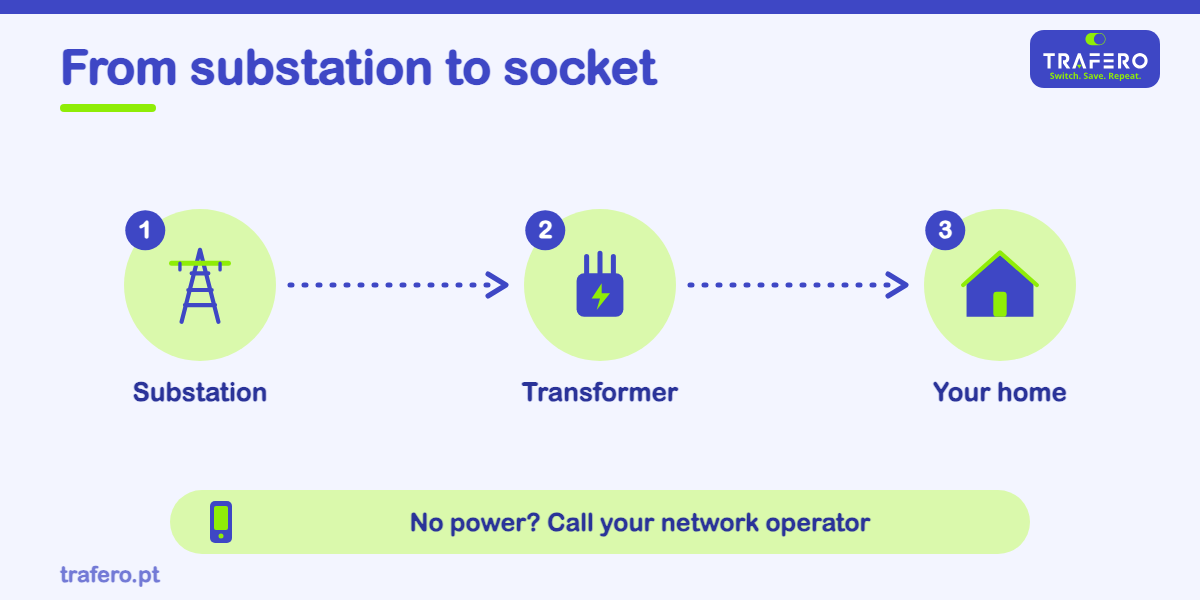
From the substation to the socket
Electricity arrives from the big lines at substations, where it drops to lower voltages (medium and low voltage). From there it travels along lines, cables and transformer stations, the "boxes" you see in the street, until it reaches your home.
Who runs these networks?
Distribution is run by DSOs, usually one main operator per area. Examples are E-REDES in Portugal, Enedis in France, e-distribución and i-DE in Spain, e-distribuzione in Italy and E-Distribuție in Romania. They look after grid connections, line maintenance, meter readings and the technical quality of the service.
The power is out: who do I call?
A fault on the network is a matter for the distribution network operator, not your supplier. So if the power fails, contact the distributor for your area. Its details usually appear on your bill.
What if I change supplier?
Nothing changes on the network: the cables, the meter and the distributor stay the same. What changes is the company that sells you the energy, the supplier. Smart meters help operators know their networks better and let you follow your own consumption.