
Who regulates the energy market? National regulators and ACER explained
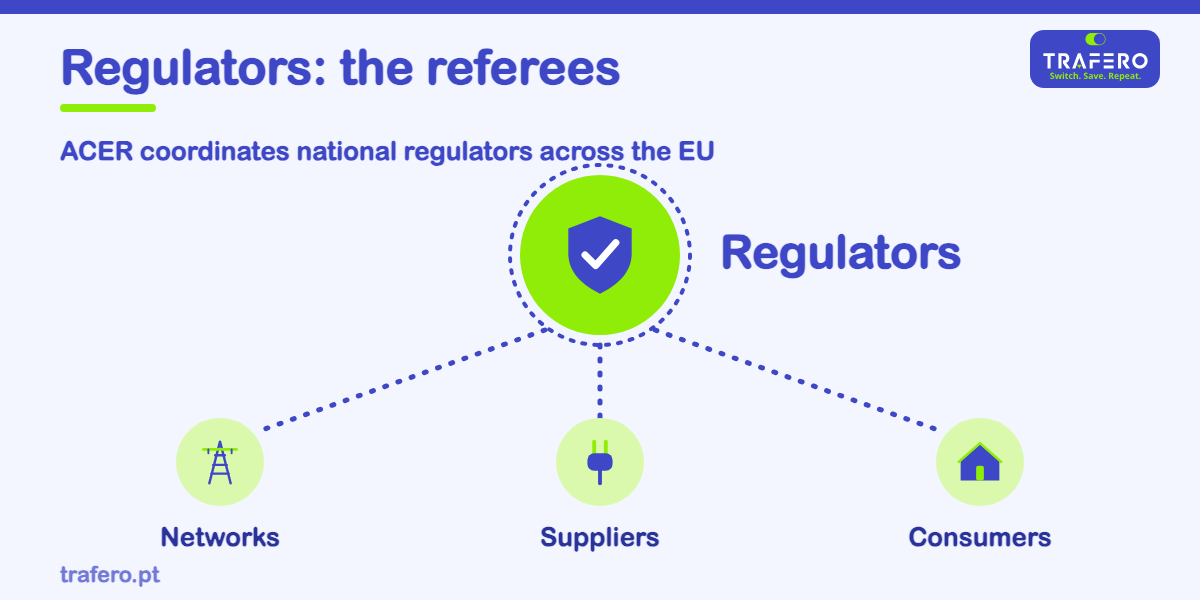
In short: every EU country has an independent energy regulator, and an EU agency called ACER helps them work together. They are the "referees" of the energy market.
This is Part 8. We talked about regulated tariffs; who sets them?
Why do we need referees?
Electricity generation and supply are open to competition. The transmission and distribution networks, however, are natural monopolies, which means it only makes sense to have one per area. With no competition to keep network prices in check, an independent body must do it.
The national regulator
Each country has one, for example ERSE in Portugal, CNMC in Spain, CRE in France, ARERA in Italy and ANRE in Romania. A national regulator:
- Sets or approves the network access tariffs that all suppliers pay.
- Oversees the market so that rules are clear and companies are treated equally.
- Protects consumers, for example on tariffs, prices and service quality.
- Provides information and often tools to compare offers.
ACER and the EU rules
ACER, the Agency for the Cooperation of Energy Regulators, coordinates national regulators, helps build common network and market rules and monitors the markets, including against manipulation. A European regulation on wholesale market integrity and transparency (REMIT) helps make sure prices are fair and nobody profits from market abuse. In 2024 the EU reformed its electricity market rules, strengthening consumer protection and ACER's role in cross-border cases.
And what do I get from this?
You get the freedom to choose and to switch, with strong consumer protection built into EU law. See, in Part 9, how to switch at no cost.